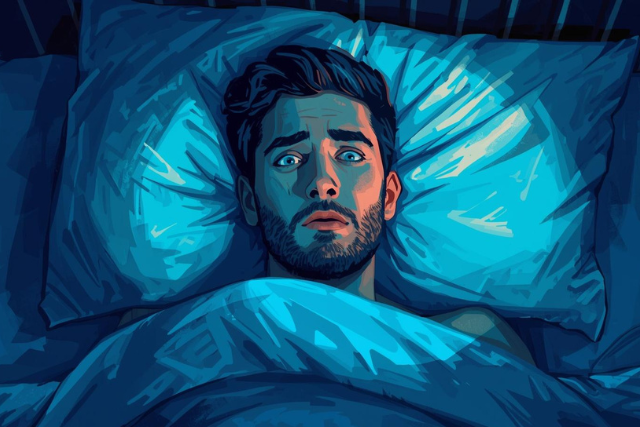
“The anxiety isn’t the foe. It serves as the herald. The blunder lies in slaying the herald instead of interpreting the message.” ~Unknown
It’s 3 a.m. Here I am, in bed, envisioning my own memorial.
Not due to any particular issue. My family is safe, and there’s no crisis. Nevertheless, my mind insists that the headache I experienced is something deadly. I’m contemplating who will show up, who will grieve, and who will bounce back too quickly.
An hour ago, my mind determined my career had ended. I have a presentation scheduled for tomorrow, and I pictured myself blanking out, witnessing my boss’s disappointment. Earlier, a friend hadn’t replied to a message I sent. By 2 a.m., I was convinced the friendship had come to an end. She loathed me. Everyone did. I had performed an unpardonable offense that I couldn’t recall.
This is the effect of night—morphing minor worries into certainties, a headache into a tumor, silence into rejection, crafting disasters from thin air, with immense creativity and no compassion.
For years, I believed something was wrong with me.
I was wrong.
The reality of 3 a.m. anxiety is that your brain isn’t failing. It’s functioning exactly as it was meant to. When I truly realized this, everything shifted.
Reflect on human history. Nighttime was once perilous. Predators and foes roamed in darkness. Those who relaxed after dusk didn’t survive to become our ancestors. The survivors kept vigilant, scanning for danger, envisioning the worst, and preparing for it.
Those individuals had descendants, eventually leading to me, in a secure room, in a city with locked doors, distanced from any legitimate threat, yet with a mind still operating on ancient survival instincts.
The genuine threats have vanished. However, the brain remains unaware of that.
So it fabricates new threats—an unanswered text, a headache, a presentation—transforming anything into a motive to stay awake. Not to torment you, but to safeguard you in the only manner it knows.
The first lesson was recognizing that 3 a.m. anxiety isn’t an assault but a misguided form of concern.
The second lesson was more challenging.
A genuine catastrophe and a fictitious one feel identical at 3 a.m.
Heart racing, icy hands, tense stomach—all physical reactions brought on by thoughts. Just thoughts, images in the mind that don’t exist elsewhere, yet the body responds as though the threat is present.
If you picture biting into a lemon, your mouth salivates. The body cannot distinguish between reality and vivid imagination. It readies the body for whatever the mind anticipates.
At 3 a.m., I expended real energy on imaginary situations, leaving me drained by morning. The scenarios never occurred. My anxieties were largely baseless. The real predicaments were unforeseen.
I attempted breathing techniques, counting, meditation apps. At times they provided relief, mostly they didn’t, as I perceived anxiety as an adversary and you cannot overcome it by fighting harder. Resistance is exhausting.
What ultimately aided me was something simpler and more unusual. I ceased trying to eliminate it.
I didn’t surrender, but recognized that the thoughts would arise. I observed them rather than contesting, treating them as one might treat a concerned friend: with patience, without acquiescence.
The thought would proclaim: “This headache is lethal.”
Instead of countering it, I would think: “Yes, that’s a terrifying notion. We’ll see if it proves true in the morning.”
The thought would assert: “Your friend despises you.”
I’d respond: “That’s a possibility. We’ll discover the truth. There’s nothing to address at this moment.”
This created a tiny void—a sliver of space between me and my brain’s narrative. I was no longer in the disaster film but observing it. The calamities lost some of their power.
One thing to bear in mind in the shadows: right now, this very moment, nothing is amiss.
Not tomorrow, not next week, not future uncertainties. Right now, there’s a dim room, a serene house, a warm, safe body. That’s what is tangible.
The future is imagination. The past is recollection. Only the present is real. And usually, if examined truthfully, now is fine.
This doesn’t clear the mind, but it creates space to breathe, establishing enough distance to wait.
Morning always arrives.