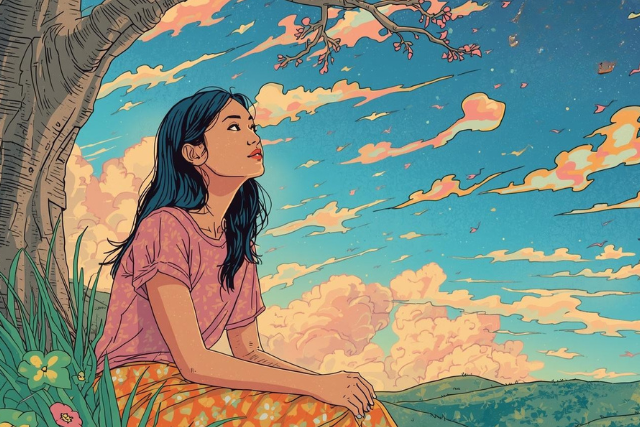
“When you awaken in the morning, reflect on what a valuable privilege it is to be alive—to breathe, to contemplate, to savor, to care.” ~Marcus Aurelius
Gratitude.
It was once a very triggering idea for me, and at times it still can be.
It has taken time to grasp what it signifies for me and to accept the days when I feel nothing to express gratitude for. It’s fine to experience those moments.
Gratitude is merely one of the numerous tools I’ve employed to alter my viewpoint on my situation (when I’m able) and feel slightly better—and it’s one of the elements that has sustained my life.
Statistically, I should not be here. Not just alive, but also healthy and secure.
Are you familiar with the ACEs (adverse childhood experiences) test? I received a score of ten out of ten, indicating a greater risk of mental, physical, and behavioral health challenges, along with a diminished life expectancy.
My upbringing was tumultuous. I had parents who were heavily addicted to crack, and I endured physical, sexual, and emotional abuse. Drug dealers frequently came and went, and Children’s Aid workers were regular visitors.
I often wondered whether I would return from school to find my parents had overdosed. There were days when they locked themselves in their room for days on end, causing me intense anxiety.
Family members and friends frequently found themselves in jail, on the streets, battling addiction, or dying young.
There were instances when we faced eviction, and times when food was scarce, leading me to hide oatmeal packets in my room. Chaos. Perhaps you can relate?
This is where gratitude entered the scene. It might seem improbable to find gratitude amidst such a nightmare, right? Call it unrealistic optimism, but I discovered reasons to be grateful.
A teacher believed in me? Grateful. I had lunch and dinner today? Grateful. My parents are alive? Grateful. I wasn’t physically harmed today? Grateful.
Navigating my childhood instilled in me an amplified sense of gratitude. I believe we all possess this, even though it can sometimes be tricky to access, and that’s perfectly fine. When we can, it can be truly beautiful.
At times, I feel so grateful that I shed joyful tears. I reside in a safe environment where I can eat without fearing harm? Wow. Gratitude doesn’t need to be linked to trauma or sadness either. You mean I can get clean water from the tap? Grateful.
I have all my limbs. I can see. I can write. I can read. I own a smartphone. I can drive. Grateful.
Occasionally, if we pause and ponder what we appreciate, it can fundamentally alter our brain. The more we concentrate on gratitude, the more we observe and identify things to be thankful for. It shifts to our default setting.
Please understand me. I’m not advocating for pretending everything is flawless. (But when was the last time you noticed and valued a rainbow?) We all undergo pain. Unfortunate events occur.
To survivors of sexual abuse, hello, how are you? I see you. To survivors of domestic violence, hi, it’s nice to meet you. I listen to you. I stand with you.
Life can be exceptionally challenging. I have complex post-traumatic stress disorder, which I’ve learned to accept. Some days I feel like discarding gratitude altogether.
Yet I recognize that it substantially impacts my mental well-being, so I continue to practice it.
Here are some pragmatic tips and insights I’ve gathered from gratitude. Don’t take these as strict guidelines or judge yourself on a gratitude scale. If they’re not feasible, that’s okay.
Starting (and concluding) your day with gratitude is transformative.
Beginning your day with gratitude can positively shape the remainder of your day. It doesn’t have to be a complicated ceremony; a singular moment upon waking is sufficient. You deserve that instant.
To keep it straightforward, think of one thing you’re thankful for.