**“I may not teach, love, or demonstrate anything flawlessly, but I will allow you to witness me, and I will forever cherish the privilege of truly seeing you—profoundly and genuinely.” ~Brené Brown**
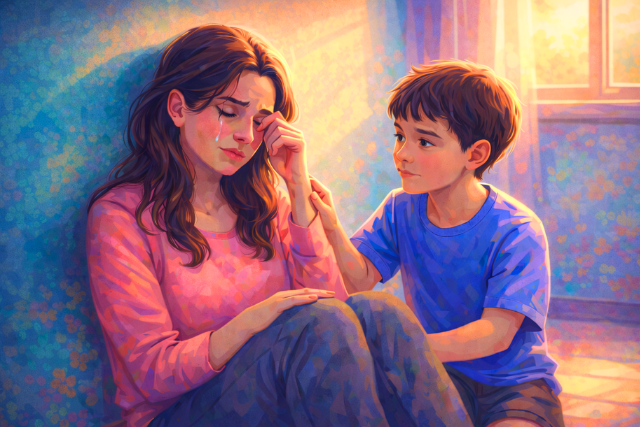
The first occasion my children witnessed my genuine tears was on Christmas in 2021. My eldest was sixteen, while my youngest was twelve. They had just unwrapped their gifts. It should have been a cozy, cheerful morning. Instead, I turned away towards the foyer by the entrance of the house, facing away from them, as tears threatened to fall. My mother—whose emotional turmoil had impacted a significant portion of my existence—was once again in a psychiatric facility. Her mental state had deteriorated again, and the sorrow of it all, the cycle, the powerlessness, finally overwhelmed me. I had spent years attempting to keep my anguish hidden. I thought I could conceal it again. Yet this time, I couldn’t.
Both of my children inquired, “Are you alright?” I mumbled, “I’m okay,” even as the tears rolled down.
**Then something unforeseen occurred. They both approached me and enveloped me in an embrace. No apprehension. No bewilderment. Just love. Unadulterated and unwavering.**
That moment started to unravel something within me. What I encountered was gentleness. My children were not overwhelmed by my sorrow. They simply reacted to it. In that moment, something long-held began to fracture: the notion that my pain was a threat to those I loved the most. I had spent so much time trying not to mirror my mother. I always felt accountable for her emotions and well-being, and I never wanted my own kids to carry the same burdens I had. But in my effort to avoid repeating the past, I kept my emotional world tightly shielded when I was upset. I believed I was safeguarding them. What I didn’t realize then was that my children didn’t need shielding from my humanity. They required a connection to it.
In late 2023, my younger child made a remark that highlighted my concealment wasn’t effective.
**“You’re the sad one,” he stated, “and Dad is the mad one.”**
The truth was painful, but I understood he wasn’t being unkind. He was merely expressing his observation. And he wasn’t mistaken. Following that Christmas, I reverted to suppressing everything and attempting to hide my sorrow. But even in the absence of tears, my son had still been aware of my sadness for years—through what was occurring with my mother, through silent losses I bore, through burdens I believed I was managing alone. Naturally, he felt it. Perhaps it was in my demeanor or energy, in the weight on my face, in the moments I occasionally zoned out, or in the times he had to call my name multiple times before I returned. He frequently asked, “Are you okay, Mommy?” He sensed something was amiss.
That was when I realized hiding my inner feelings was futile if my children could already perceive them without words. Children possess remarkable intuition. Even without the vocabulary, they can sense what’s transpiring. They detect tension, sorrow, distance, and strain long before anyone articulates it. When we pretend everything is fine, they still sense that something is not right.
**What I started to comprehend is that in the absence of context, they were left to derive meaning from what they felt. They might assume my sadness related to them or that it was something they needed to resolve.**
However, when I began to share enough truth with them—without overwhelming them with trauma, without placing my burdens on their shoulders—they were better equipped to not take personally what they were perceiving. They could grasp that I experienced feelings, that those feelings were valid and human, and that those emotions were not their responsibility. I also began to notice something else.